Fresh Today
A Concept for Enough.
My Role
UX Research
Timeline
10 weeks
Collaborated with
Client, Experience Haus Classmates (based in London)
Tools & Methods Used
Tools: Figjam
Methods: Stakeholder Interview, Contextual Inquiry, User Interviews, Affinity Diagram, 2×2 Matrix, MSCW Prioritization, Personas, Crazy 8s, Effort vs. Impact Matrix, Storyboarding
What is the problem? Why does it matter?
Context
There are millions of people in the UK facing food insecurity while hundreds of thousands of tons of edible food are wasted annually. In numbers:
9+ million people risk relying on food banks
240,000 tons of food wasted by the grocery sector each year
$1 billion worth of edible food binned--equating to 190 million discarded meals
41.9% of Universal Credit households experience food insecurity
Yet only 9% of supermarket food waste reaches charitable organizations
We don’t need to accept food poverty to just be inevitable. It is a solvable system challenge.
Constraints
Enough. is based in London and was pre-funding at the time of this project.
User access limitations: Due to the sensitive nature of the problem space, the target user group was difficult to reach for first-hand research.
Where did I start?
Challenge Given: How might we transform access to affordable, nutritious food (creating food security) whilst eliminating food waste.
Proposed Solution: A dual platform solution, one for retailers and one for families, can transform how surplus food is redistributed and accessed, solving both a 1 billion pound supermarket waste problem and growing food insecurity.
I was asked to use research to validate this proposed solution or provide research for why there is a better solution. I was expected to challenge assumptions and uncover unmet needs.
After reviewing the project brief and conducting an initial client interview, we defined the research problem and research goals.
Research Goals
Understand what factors influence food purchasing decisions among low-income consumers (price, nutrition, convenience, trust, etc.).
Explore how low-income consumers currently access nutritious food and what barriers prevent them from doing so.
Identify opportunities to connect surplus food with low-income consumers in ways that feel trustworthy, convenient, and empowering.
Assess whether digital tools could support food planning or purchasing for food-insecure families.
Research Problem
We don’t know what low-income consumers value (price, nutrition, convenience, brand trust) when it comes to food.
Research Research Research
I conducted…
Foundational Desk Research - to understand how surplus food is currently being managed, operational feasibility, incentives, and constraints
Primary Field research - to reveal real decision-making in context, not just stated preference as well as behavior and attitude around accessing food
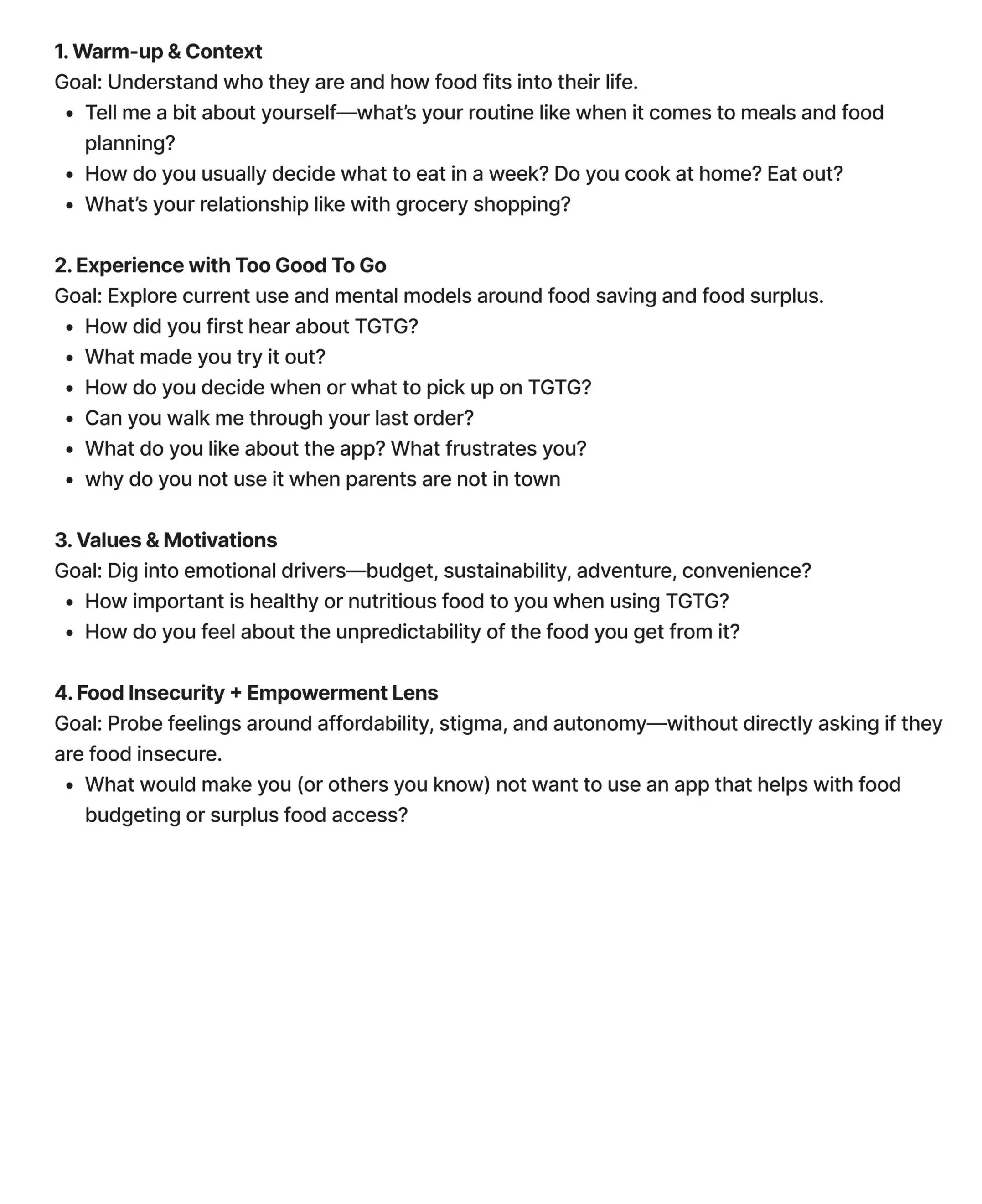
4 Contextual Inquiries: grocery shopping with 4 moms in the low income community of San Diego (City Heights) to Food4Less, Smart & Final, and Costco
1 Observation at a recovering addict center
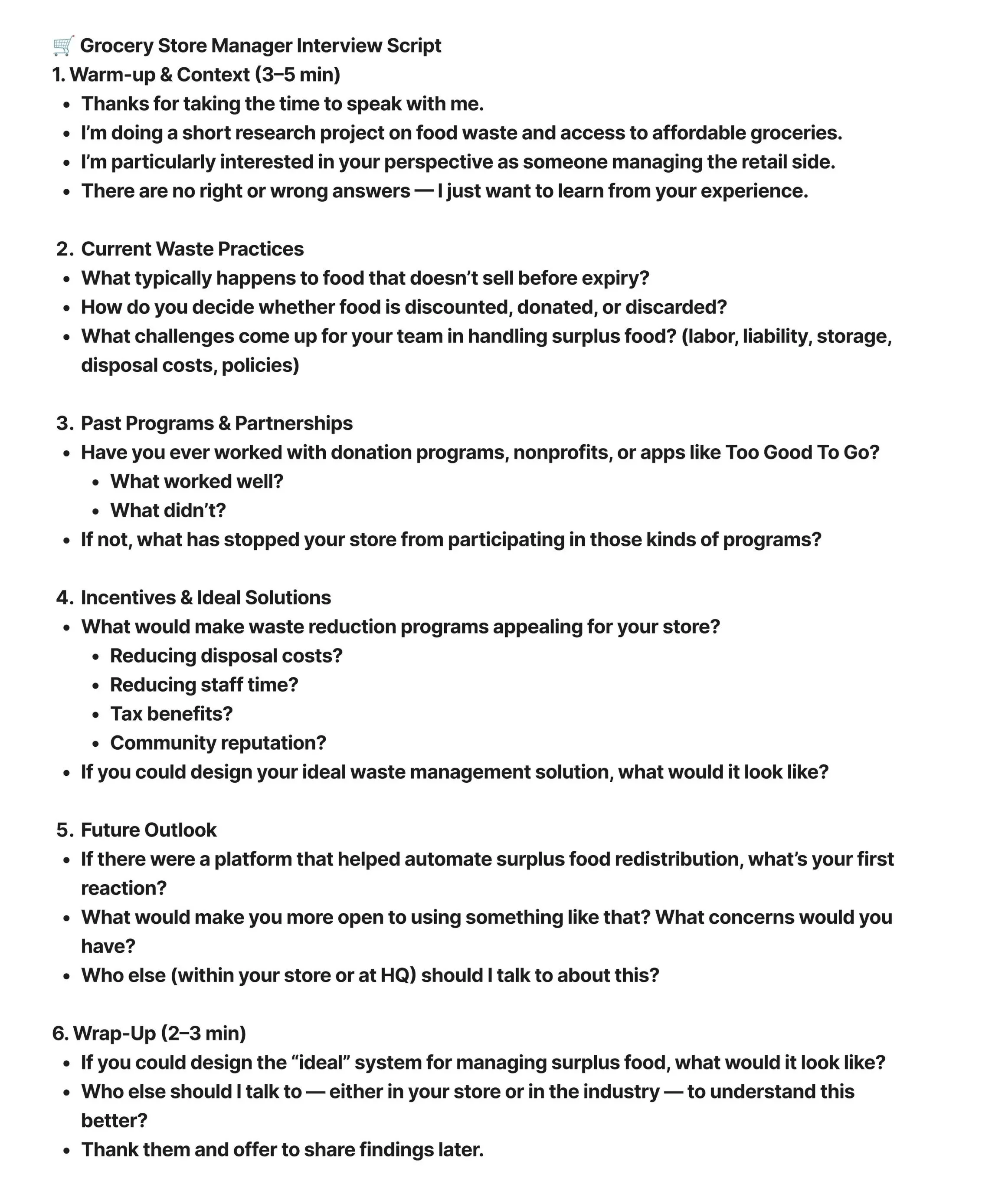
3 User Interviews with Grocery Store Managers: Ralphs, Vons, Albertsons
asked questions around current waste practices, past programs & partnerships, incentives & ideal solutions, future outlook
Supporting research - to understand current usage patterns of a similar app, to assess trust and how to integrate into daily life
4 Analogous Interviews: interviewed 4 Too Good to Go (a similar app) users ages 25-55.
1 User Interview with Homeless Shelter Worker
Contextual Interview Plan and Interview Guides
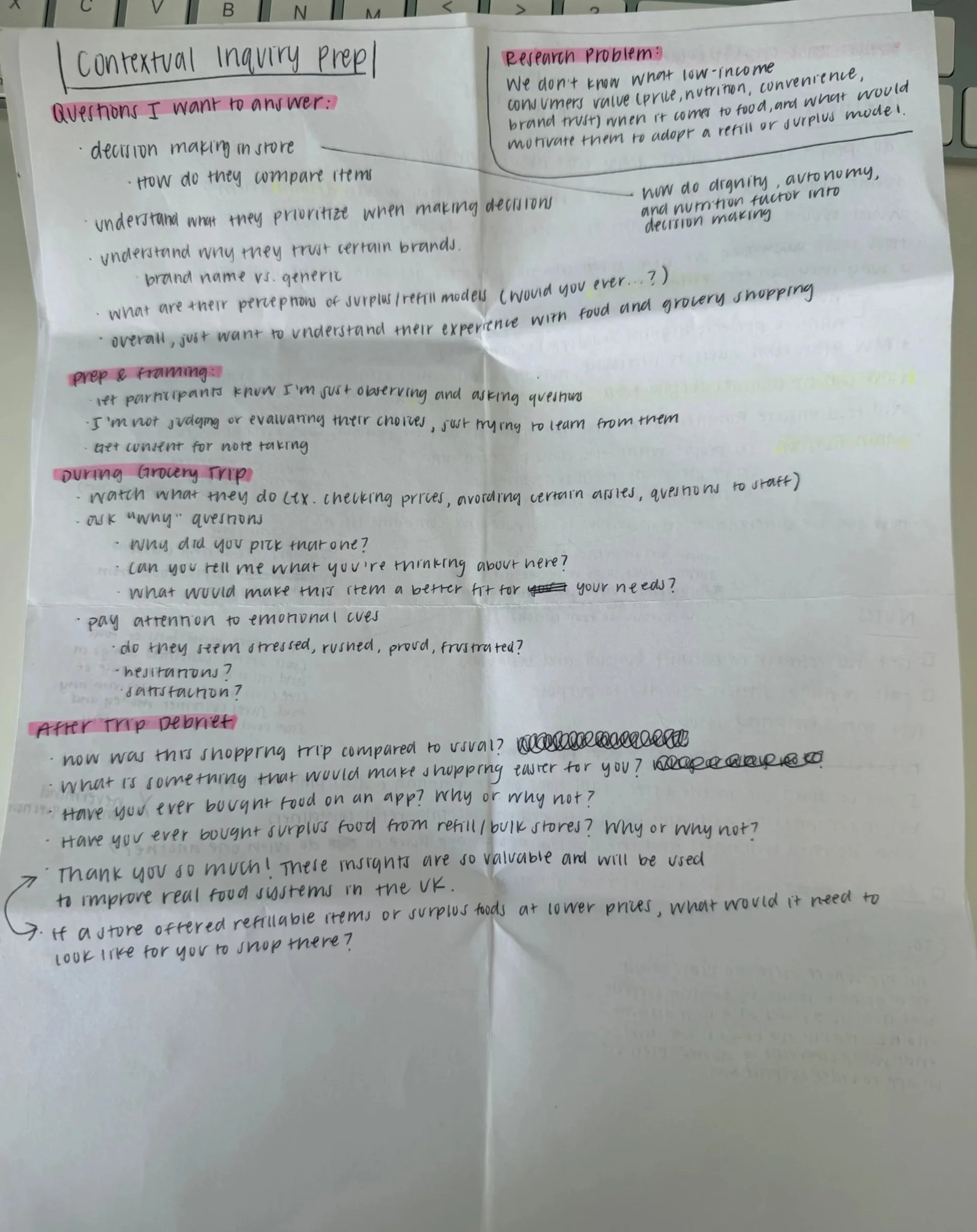
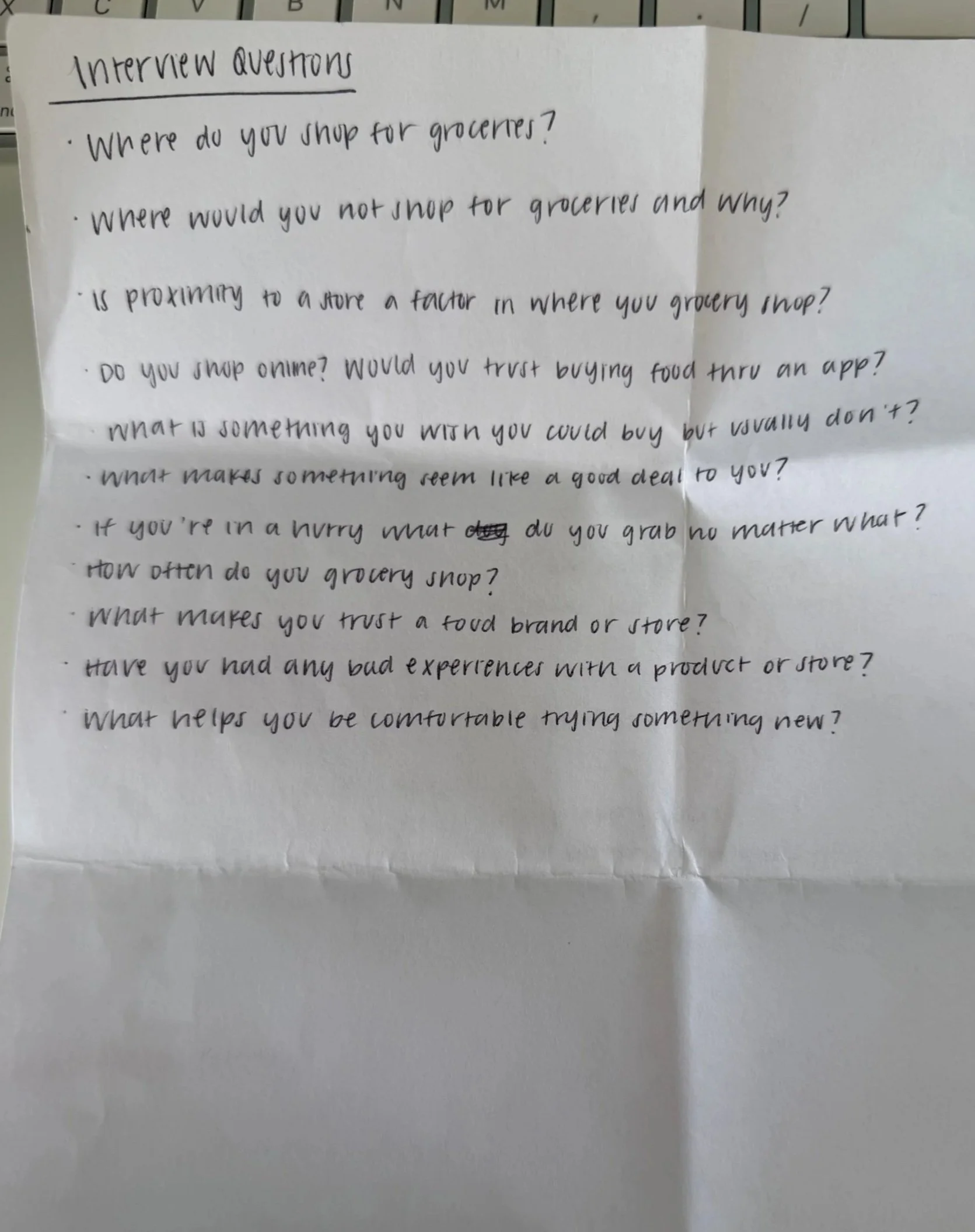
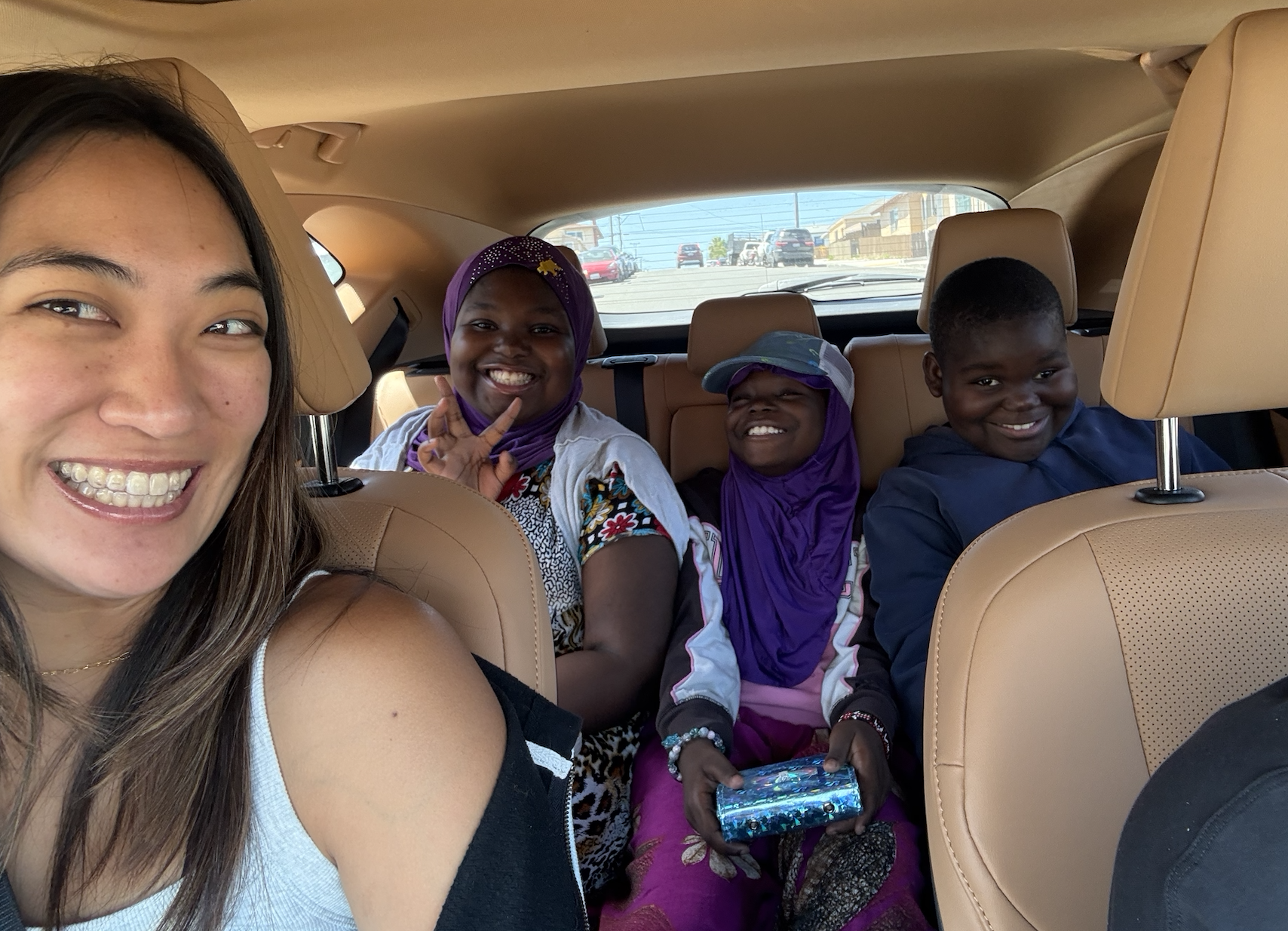
Kids came with us for one of the grocery shopping trips!
“I buy these avocados, even though they are smaller and more expensive, because they are organic.”
“I like to shop at ALDI because it is healthy, cheap, and really close.”
In Action!
“I don’t like working with donation programs when the logistics, like transporting foods, are complicated.”
“I don’t want to use an app to buy produce because I want to be able to touch and see what I am buying.”
What did I learn from my research?
After extensive in-person research and a whole lot of sticky notes, I identified four shared values that determined whether a surplus food system would succeed.
Main methods used to synthesize: Affinity Diagramming & 2x2 Matrix (What stores value vs. what consumers value)


What I learned that wasn’t already assumed in the brief?
Grocery stores focus on reducing waste upstream and at the retail level first and then donate the food as their second priority.
What assumptions were disproved?
Consumers from low income communities are willing to spend more money on produce if it's nutritious. (Ex. spent more money on the organic avocados than just buying the non-organic avocados)
What assumptions were validated?
Both consumers and grocery store managers value lower costs.
Opportunity Spaces

Who was I really designing for?


Aligning with Stakeholders
After presenting our findings to stakeholders, we collectively decided to prioritize a solution that would ensure convenience, nutrition, and trust while still having guaranteed fresh produce. We decided that increasing operational efficiency and reducing the mental load for both consumers and managers would be later steps in the project.
Problem Statement
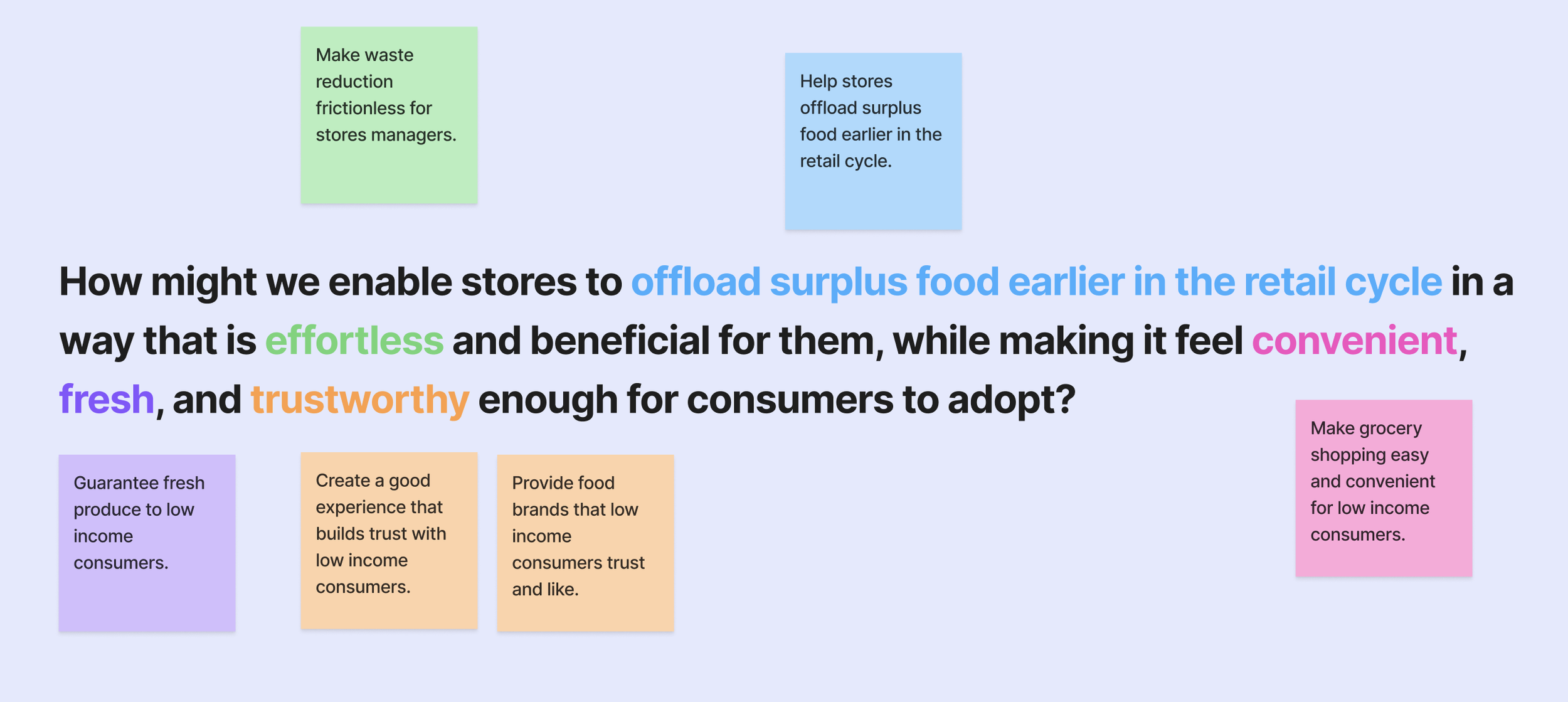
The sticky notes represent the opportunities for each key pillar of the problem statement.
** Original Problem Statement from stakeholder: HMW transform access to affordable, nutritious food (creating food security) whilst eliminating food waste.
This HMW question states the issue at hand but does not get down to the root of what users need to adopt a new system that solves food waste and food insecurity.
Ideation
Crazy 8s

Doing Crazy 8s independently was far more difficult than when I first did it with classmates, reinforcing how valuable collaborative ideation is for generating diverse and unexpected ideas.
Effort vs. Impact Matrix

I first starred ideas that appeared most promising. From this group, I then identified the concepts that seemed most feasible to implement, marking them with green thumbs-up icons to guide prioritization.
Evaluating the Concepts
The impact–effort matrix helped surface two concepts with strong potential. I then evaluated these ideas more deeply to determine which direction to pursue.
How does this solution address the opportunity spaces identified earlier?
What would make adopting this solution worthwhile for Michael in terms of time and cost?
How does the solution support or improve Michael’s revenue model?
What competing solutions already exist, and how does this concept differentiate itself?
Why would consumers choose this option over cheaper fast food alternatives?
Final Proposed Solution
After evaluating both concepts, a dollar section and an automated markdown system, I selected the automated markdown system as the direction to pursue. This concept most effectively supported the four key pillars (convenience & simplicity, freshness, cost, and nutrition & trust) while addressing the key opportunity spaces for both Jennifer and Michael. After iterating on this idea, I came to the solution of Fresh Today.

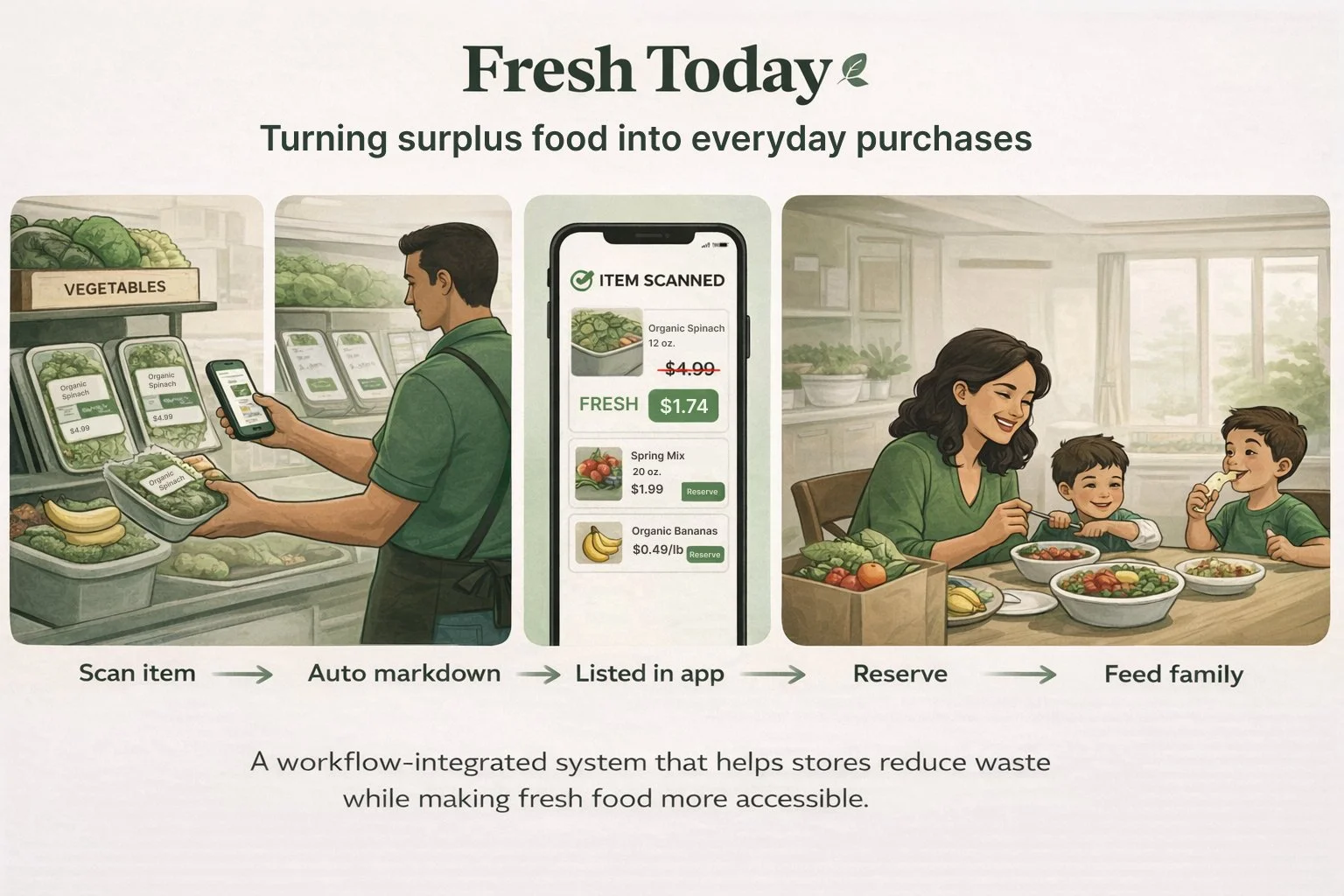
Fresh Today
A simple surplus system that lets staff scan and auto-markdown near-expiry items during normal restocking, which automatically lists them in the store’s app for real-time pickup.
Staff scan → price updates → item auto-appears in “Fresh Today” section in app → Jennifer reserves in app → goes in-store for pick up
Users can apply for a membership that allows them early access to food on the app. Eligibility through existing program such as SNAP or WIC benefits.
Freshness score on each product to gain user’s trust.
Requires almost no new training or tools for grocery staff.
This system creates a fast, trustworthy, and affordable channel for surplus food.
Why does this work?
Why is this solution worth it for Michael?
Michael achieves his goals of cutting disposal costs and increasing waste reduction at this Vons while also meeting his needs and expectations of operational ease with minimal to no added effort. In other words, he makes money with very minimal added effort.
Why is this solution valuable for Jennifer?
Jennifer gets very affordable groceries that are still fresh and because she can browse on her phone beforehand, the food she reserves is food her household will eat.
How is this better than competition?
Research showed store staff avoided surplus programs that added extra steps. Fresh Today reduces participation to a single additional action: scanning an item during restocking. Fresh Today optimizes on staff behavior as opposed to optimizing the surplus system.

Impact & Validation
This solution depends on both adoption and trust.
To measure impact I would use a combination of Wizard-of-Oz Testing and User Surveys to learn whether users actually reserve near-expiry items in a realistic shopping scenario, and whether it feels safe and worth the effort.
Measure
Reservation rate
Trust in food safety
Likelihood of repeat use
Observe
What users select
Where hesitation occurs
Survey
Willingness to purchase near-expiry food
Confidence in safety
Perceived value
If validated, this would show that near-expiry food can become a trusted, everyday purchase, reducing waste while improving access to affordable groceries.
Reflection
Note: The project started as a 10-week course project with Experience Haus, but the problem space stayed with me. After the course ended I continued the research independently, adding 2 more contextual inquiries, 3 more user interviews, 3 more analogous interviews, and more desk research. My findings and proposed solution changed significantly as a result.
If I continued this project from here on out, I would want to do more research on the most severely food-insecure communities. My solution only works for the low income community, but I would like to figure out ways to help the target community.
A key challenge was limited access to users: this was a hard community to reach as I want to be respectful and not talk to make them feel like they are a “project.” In addition, grocery store managers were very uninterested in talking to me, so they each only gave me around 5 minutes max to ask them questions.
This experience taught me the value of continuous research. After finishing the project, I would go about my day to day life and anytime I came across someone who works at a homeless shelter or heard of friends of friends, I would immediately have so many questions to ask and each time I learned so much more. This would be a fun project to keep iterating on as I learn more and more.